image by Castorly Stock
Mesa Arizona Real Estate Market 2026
The East Valley's Best Value Is Running Out of Time
Mesa doesn’t announce itself.
It doesn’t have Scottsdale’s reputation or Gilbert’s momentum story or Chandler’s tech corridor headlines. It just sits there — third largest city in Arizona, fifth largest city in the entire United States by some measures — quietly doing everything right while everyone else gets the attention.
That’s ending. The numbers are making sure of it.
Where Prices Stand Right Now
The median home price in Mesa sits at approximately $400,000 as of early 2026 according to Zillow Research. That number represents one of the most compelling value propositions in the entire Phoenix metro when you consider what Mesa actually delivers — full urban infrastructure, major employment anchors, light rail connectivity, and neighborhoods that compete directly with cities charging significantly more.
Redfin currently places Mesa average days on market at approximately 44 days — moving with steady consistent momentum that reflects genuine organic demand. Not speculative fever. Not artificial urgency. Real buyers making real decisions based on real value.
The price trajectory tells an important story. Mesa’s median home price in 2019 sat around $255,000 according to Zillow. That’s approximately 57% appreciation in six years — outperforming the national average and matching or exceeding most comparable Arizona markets that carry significantly more name recognition.
Buyers who dismissed Mesa six years ago and chose trendier alternatives paid more and got less. That lesson is worth learning before repeating it.
The City Nobody Bothered To Understand
Mesa suffers from a perception problem that its residents find both frustrating and financially convenient.
The frustrating part — nobody gives Mesa credit for what it actually is. A genuinely diverse, genuinely complex city with historic neighborhoods, a world class arts scene, major league spring training, a rapidly transforming downtown, and residential pockets that belong in conversations with the best neighborhoods in the entire metro.
The financially convenient part — that perception gap keeps prices below where fundamentals suggest they belong. And perception gaps in real estate close eventually. They always do. The buyers on the right side of that closing tend to build wealth quietly while everyone else is still arguing about whether Mesa deserves attention.
The U.S. Census Bureau places Mesa’s population at approximately 510,000 people — larger than Atlanta, Minneapolis, or Miami. Cities that size don’t stay undervalued indefinitely.
Downtown Mesa — The Transformation Nobody Is Talking About
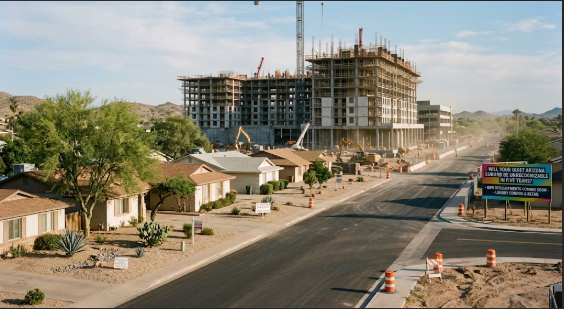
Main Street in Downtown Mesa is mid-transformation in ways that reward buyers paying attention right now.
The Mesa Arts Center on Center Street — one of the largest arts complexes in the entire Southwest according to the City of Mesa — anchors a cultural district that has been quietly attracting restaurants, galleries, and creative businesses for years. The light rail line running through downtown connects Mesa directly to Tempe, Phoenix Sky Harbor Airport, and ultimately Scottsdale — making the urban core genuinely accessible in ways that purely suburban markets cannot replicate.
The City of Mesa’s Downtown Development Reports document consistent new investment — adaptive reuse projects, new restaurant openings, residential conversions — that track a neighborhood trajectory familiar to anyone who watched similar transformations in other Arizona cities and wished they had bought earlier.
Eastmark on the far east side represents Mesa’s most ambitious new development — a master-planned community built around innovation, technology employment, and a lifestyle proposition that specifically targets the demographic that has been driving East Valley real estate demand for a decade. Redfin identifies Eastmark as one of the fastest growing residential submarkets in the entire metro.
The Employment Story
Mesa’s economy rests on a foundation diverse enough to weather cycles that purely tech-dependent or government-dependent markets cannot.
Phoenix-Mesa Gateway Airport on the city’s eastern edge has transformed from a regional facility into a legitimate commercial aviation hub — with Allegiant Air operating significant operations there and passenger volumes growing consistently according to the Maricopa Association of Governments. Airport adjacent real estate markets historically benefit from employment density and infrastructure investment in ways that compound over decades.
Boeing maintains significant operations in Mesa — specifically its Apache helicopter production facility that represents one of Arizona’s most significant advanced manufacturing employers. The Arizona Commerce Authority tracks aerospace and defense manufacturing as one of the state’s highest wage employment sectors — creating housing demand from a worker profile characterized by stable income and strong mortgage qualification.
Banner Health operates multiple major facilities in Mesa — anchoring healthcare employment that the Arizona Commerce Authority identifies as one of Arizona’s fastest growing and most recession-resistant sectors. Healthcare workers buy homes. They stay. They become the stable homeowner base that defines neighborhood quality for decades.
Mesa Community College and Chandler-Gilbert Community College campuses create the educational infrastructure that employers specifically evaluate when making location decisions — reinforcing the employment ecosystem in ways that support long term population growth and housing demand.
Spring Training — The Economic Engine People Underestimate
Mesa hosts two MLB spring training facilities — Sloan Park home of the Chicago Cubs and Hohokam Stadium home of the Oakland Athletics — making it one of the highest concentration spring training markets in the entire Cactus League according to MLB.com.
The Cactus League Association estimates the annual economic impact of spring training in Arizona at over $900 million — with Mesa capturing a disproportionate share as the host of two franchises including the Cubs whose fanbase travels in volumes that other teams genuinely envy.
That economic activity supports hospitality, retail, and restaurant employment that stabilizes Mesa’s economic base beyond what pure residential demand provides. Markets with genuine tourism infrastructure historically show real estate resilience that purely residential markets cannot match.
The Neighborhoods Defining Mesa’s Market
Mesa’s geographic size — larger than the entire city of San Francisco — means neighborhood selection matters enormously.
Red Mountain in northeast Mesa consistently delivers the city’s most dramatic lifestyle proposition. Homes built against the Red Mountain backdrop with views that belong on screensavers and access to Usery Mountain Regional Park for hiking and outdoor recreation. Zillow tracks Red Mountain area median prices approaching $480,000 — reflecting a premium that buyers who’ve seen the views consider entirely justified.
Las Sendas in the same northeast corridor represents one of Mesa’s most consistently appreciated master-planned communities — golf course living, mountain views, and a resident profile that reflects genuine affluence. Properties here move faster than the broader Mesa market and hold value through cycles that affect more generic inventory more severely.
Downtown Mesa’s historic neighborhoods — particularly areas around Robson, University Drive, and Country Club — represent the city’s most compelling value opportunity for buyers who understand neighborhood transformation trajectories. Current prices here sit well below comparable historic districts in Tempe and Phoenix — a gap that reflects awareness rather than quality.
Eastmark as mentioned above delivers the city’s most ambitious new construction story — purpose-built for the demographic that has been defining East Valley demand and priced at levels that still undercut comparable new construction in Gilbert and Chandler meaningfully.
Southeast Mesa along the Ellsworth and Meridian corridors offers newer construction at price points that first time buyers can realistically access — the Arizona Association of Realtors identifies this corridor as one of the metro’s most active entry-level markets by transaction volume.
The Investment Case
Mesa’s rental market makes the investment argument efficiently.
Zillow places average Mesa rents at approximately $1,600 per month for a two bedroom — delivering rental yields relative to purchase price that outperform most comparable Phoenix metro markets where acquisition costs have outpaced rental rates significantly. The combination of lower entry prices and competitive rents creates cash flow dynamics that investors in pricier markets actively seek and rarely find.
The student population at Mesa Community College and nearby Arizona State University — accessible via light rail — creates consistent rental demand in neighborhoods adjacent to transit corridors that doesn’t fluctuate with broader economic conditions the way purely employment-driven rental markets do.
The Arizona Department of Housing identifies Mesa as one of the state’s markets with the strongest ratio of rental applications to available units — structural undersupply that supports both occupancy and pricing power for landlords operating here.
The Honest Part
Mesa is a big city. Big cities have uneven neighborhoods — and Mesa is no exception.
Some western Mesa corridors reflect decades of deferred investment that the city is actively addressing through targeted revitalization programs documented in Mesa’s General Plan. Buyers doing neighborhood level due diligence will find meaningful quality differences between Mesa’s strongest and weakest submarkets — differences that justify working with an agent who knows the city at street level rather than relying on broad city-wide statistics.
That neighborhood level complexity is also where opportunity lives. The buyers who understand Mesa’s internal geography — who know which corridors are transforming, which neighborhoods are undervalued relative to their fundamentals, which streets are about to benefit from announced infrastructure investment — those buyers consistently outperform the market.
Mesa doesn’t reward passive buyers. It rewards informed ones.
The Bottom Line
Mesa in 2026 is exactly where Tempe was a decade ago and where Gilbert was seven years ago — a city whose fundamentals have outgrown its reputation and whose prices haven’t fully caught up to what it actually delivers.
That gap closes. It always closes. The buyers who act while the gap still exists are the ones who look back five years later and feel very good about their timing.
The East Valley’s best value is running out of time. The title of this article was not an accident.
Find your Mesa home with an Arizona Nook agent who knows this city street by street and neighborhood by neighborhood. Browse our Mesa agents today.
Sources: Zillow Research — Redfin Data Center — U.S. Census Bureau — Arizona Association of Realtors — Arizona Department of Housing — Arizona Commerce Authority — City of Mesa — Maricopa Association of Governments — Cactus League Association — Freddie Mac Weekly Mortgage Survey
Check out the Golden Agent of Mesa

The Mesa Gold Agent
This Gold spot in Mesa is available — only ONE AGENT will ever hold it Before 1st of May 2026
More of our rich Blog here